
“Freedom is Just Right Around the Corner” An Afternoon with Dr. Frank Omowale Satterwhite
2025
On April 8, 1968, four days after the assassination of Martin Luther King Jr., 70 Black Student Union (BSU) members went on stage during a panel, took the mic, and read off a list of 10 demands which included better treatment of Black Stanford students, Black Stanford faculty, and residents of East Palo Alto. This historic moment was later referred to as “Take Back the Mic”. Amongst the 70 BSU members was a then PhD student at the School of Education, was Frank Omowale Satterwhite (now going by “Omowale”) who read out loud the demands to the all-white and male panel and the 1700 majority white audience members.

It is difficult to capture with words how truly momentous this occasion was, and how it changed the material conditions available to Black students at the time. BSU’s actions that day led to the formation of what we now know as the Black Community Services Center (or “Black House”) which laid the groundwork for other community centers to be formed, an increase in Stanford’s Black student enrollment, and the piloting of the first African and African American Studies program to be formed at a private university in America.
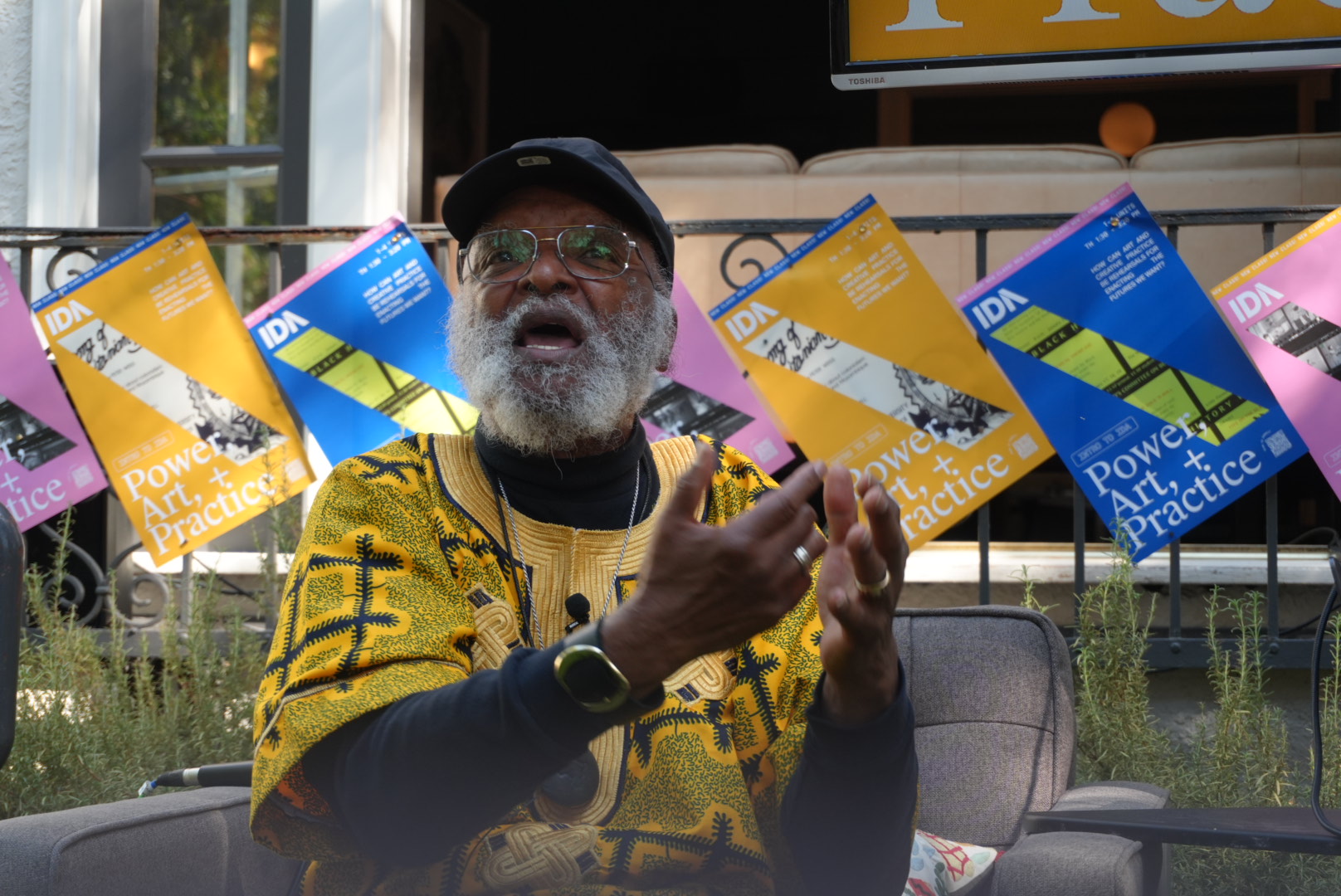
The Institute for Diversity in the Arts (IDA) welcomed Dr. Satterwhite back to campus on September 25th to speak as the first guest for IDA’s inaugural class Intro to IDA: Power, Art, and Practice. His presence was nothing short of transformative—a reminder of the wisdom, courage, and deep love that fuels our collective journey toward freedom.
Dr. Satterwhite shared his knowledge with such generosity and honesty, speaking passionately to our students about the histories of struggle and community organizing that made moments like the “Taking of the Mic” possible, but also about the important work that followed afterwards such as his assistance in more than 1,300 organizations and grassroots communities across the US. One of the most potent memories he shared was in regards to his visit to South Africa in the 1980s, where the political tension between anti-apartheid groups and the government was coming to a boil. He left South Africa in 1989, feeling hopeful that the apartheid was finally ending, but after returning to the US, he described that the propaganda against the anti-apartheid groups was so strong, that his hope was faltering. Then, in 1990, the apartheid in South Africa ended.

In recalling this story, Dr. Satterwhite charged us to remember that “freedom is just right around the corner”—a refrain that rang in our ears long after he spoke. He reminded us that the work of liberation is not only about strategy or survival, but also about relationship building, about staying convinced of the possibility of our healing and collective transformation. He modeled what it means to be rooted in legacy while alive to the urgencies of the present.
Perhaps most moving of all, he reminded us: “You never know you are making history when you are making history.” Those words feel especially resonant in this moment, as we acknowledge the transition of our beloved Assata Shakur. In her spirit, we lift up her mantra as a guidepost for our work ahead:
It is our duty to fight for our freedom
It is our duty to win
We must love each other and support each other
We have nothing to lose but our chains.
Dr. Satterwhite’s visit was medicine for our community, setting the tone for our first class of the quarter and offering a reminder that we are not alone in this work—that we are held by a deep lineage of organizers, artists, and visionaries who came before us.